
Turkish coffee has never been just a hot drink that awakens the senses; it is a deep-rooted cultural ritual, a symbol of hospitality, and a long history that spans continents. Turkish coffee is distinguished by its thick consistency and its unique preparation method that has hardly changed for hundreds of years, earning it an unmatched place in the hearts of coffee lovers.

Roots of Origin: From Yemen to the Sultan's Palace
The story of Turkish coffee began in the mid-16th century, specifically in 1555, when the Ottoman governor in Yemen, "Özdemir Pasha," presented coffee beans to Sultan Suleiman the Magnificent. The sultan was impressed by this new drink, and soon a new and innovative way to prepare it was developed in the Ottoman palace; where the beans are roasted, ground very finely, and then boiled with water in a copper pot known as a "cezve" (or ibrik).
Spread in Turkey: More than Just a Drink
The drink did not remain confined to the walls of the royal palace for long. The first coffeehouses opened in Istanbul in the "Taksim" neighborhood, and these coffeehouses quickly transformed into centers for cultural and social gathering, where thinkers, writers, and the public meet to exchange conversations.
Coffee has become an integral part of Turkish culture and daily life; it is strongly present at social occasions and is a fundamental part of marriage proposal rituals (where the bride serves salty coffee to the groom to test his patience and love for her), not to mention the tradition of fortune-telling in the coffee grounds (tasseography) that remains popular as a form of entertainment to this day.
From Istanbul to Europe and the World
With the expansion of the Ottoman Empire and the increase in trade exchanges, Turkish coffee made its way to the heart of Europe. Ottoman ambassadors and merchants played a pivotal role in introducing this luxurious drink to the European aristocracy.
In the seventeenth century, the first cafes opened in Venice, London, and Paris, inspired by Ottoman coffee traditions. Despite the evolution of coffee preparation methods in Europe later (such as the emergence of espresso and filtered coffee), the Turkish method has maintained its identity and authenticity in the Levant, the Balkans, North Africa, and the Middle East.
The preparation journey: from the green bean to the cup
To obtain an authentic Turkish coffee cup, the coffee beans undergo a meticulous journey that requires great care at every stage, as any flaw in the order or preparation may lose the coffee its identity:
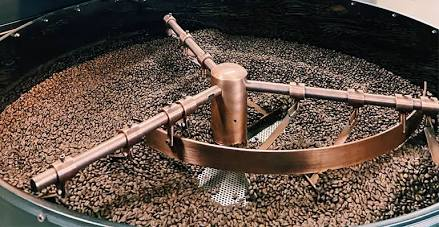
- Roasting (the secret is in the color degree): The process begins with selecting high-quality green coffee beans (often of the Arabica variety). The beans are roasted in specialized roasters until they reach the desired degree, which usually ranges from light to medium roast for classic Turkish coffee, highlighting earthy and light fruity flavors without reaching the stage of burning and extreme bitterness.
- Grinding (finer than powdered sugar): This step is the most important that distinguishes Turkish coffee from others. The roasted beans are ground using special grinders to a very fine degree, becoming almost like powder. This fineness is what gives the coffee its thick, velvety texture and allows the sediment (grounds) to settle quietly at the bottom of the cup when drinking.
- Cooking in the cezve (very low heat): A heaping teaspoon of ground coffee is added for each cup of water (preferably at room temperature) in the copper "cezve." Sugar is added at this stage according to taste (light, medium, or extra) and the ingredients are stirred well before placing them on very low heat or on hot sand according to traditional methods.
- The formation of the foam (a guide to professionalism): The coffee is left on the heat without any additional stirring until the thick foam (the face) begins to rise slowly. Before it reaches the boiling point that breaks the foam, the cezve is removed from the heat, and the foam is distributed with a spoon into the cups, then the cezve is returned for a few seconds and the rest of the coffee is poured very gently to keep the foam layer intact.
Taste authenticity with Fustuq & Hail
Turkish coffee is not just a series of steps to follow, but it is the quality of the beans, the precision of roasting, and the aroma that fills the space. If you are looking for an authentic experience that takes you back to the historical roots of this ancient drink and adorns your mornings and warm gatherings, we invite you to discover our luxurious selection of Turkish coffee.
We at Fustuq & Hail carefully select the coffee beans and roast them with passion to deliver the best possible quality to you, making your daily coffee an unforgettable exceptional experience.
Shop now from the coffee section of our online store and enjoy the authentic taste: